The Land Where Earth and Sky Collide
Few places on Earth seem to exist halfway between dream and reality, but Cappadocia, in central Turkey’s Anatolian heartland, is one of them. This surreal region—etched with honey-colored valleys, fantastical rock formations, and an underworld of ancient cities—has inspired travelers for centuries. When you first set eyes on its whimsical “fairy chimneys” rising like towers from the dusty plains, it’s easy to imagine you’ve stepped into another world. Yet beneath this fantastical landscape lies a story far older and richer than the rocks themselves: a saga of civilizations, faith, and resilience that spans millennia.
A Landscape Sculpted by Fire and Time
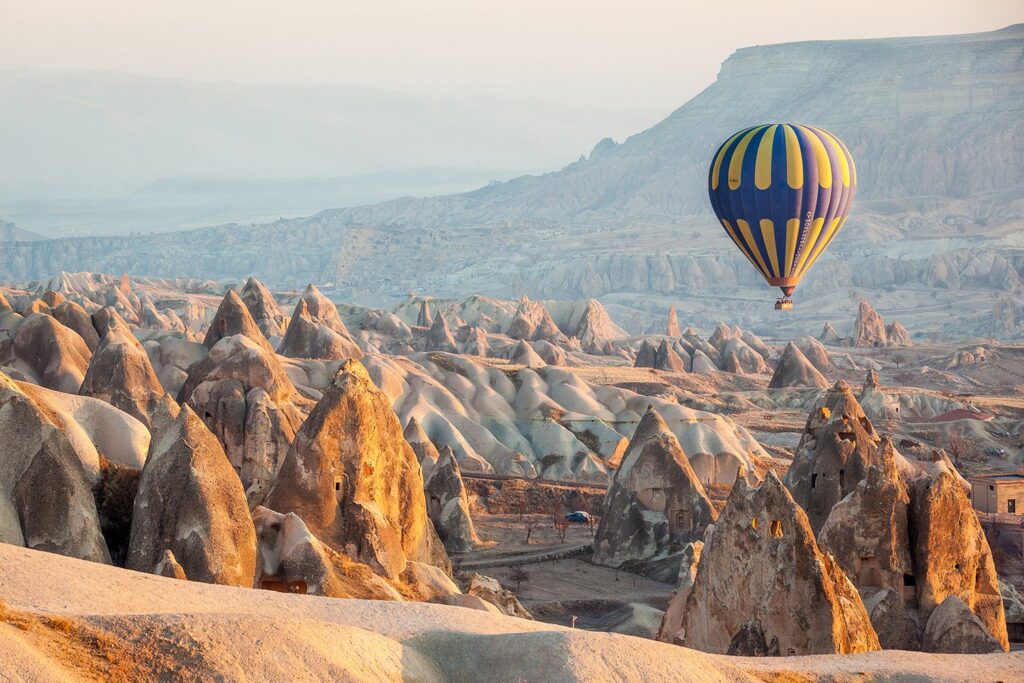
The birth of Cappadocia’s otherworldly geography began millions of years ago, forged in fire and refined by wind. Volcanic eruptions from Mount Erciyes and Mount Hasan blanketed the region in thick layers of soft tuff—ash that solidified over time into a porous rock. Nature then took on the role of sculptor: wind, rain, and frost eroded the plateau, carving deep valleys and bizarre rock pillars that now define the region’s character.
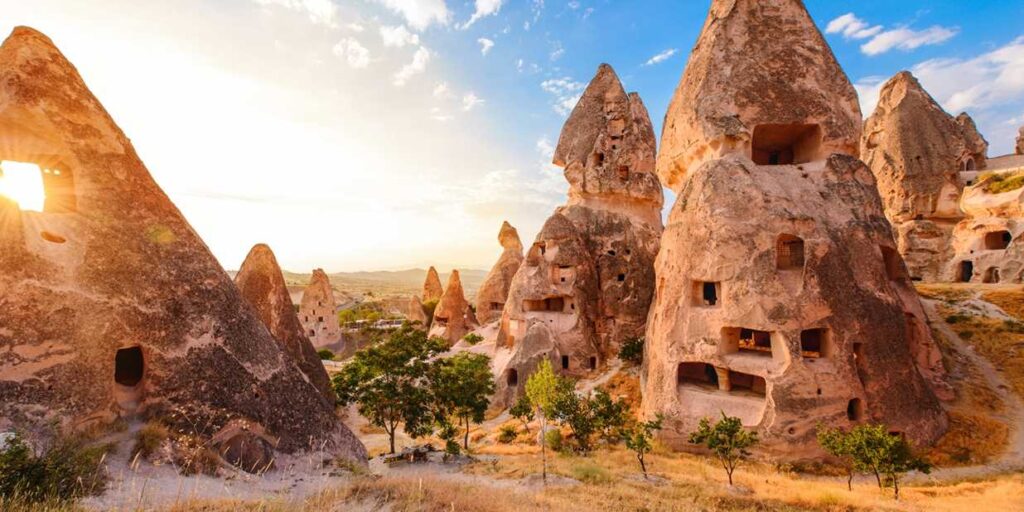
The result is a terrain that defies logic—a symphony of cones, domes, and cliffs where the hues shift from pink to gold with the movement of the sun. Locals affectionately call the stone spires “peri bacaları,” or fairy chimneys, a name that captures both their whimsy and their mystical aura. This same soft stone that shaped Cappadocia’s surface also provided its inhabitants with an unusual opportunity: it could be easily carved. And carve they did—creating an underground world of homes, sanctuaries, and cities hidden within the rock.
Life Beneath the Earth
Cappadocia’s early settlers quickly realized that their landscape offered not only beauty but protection. As various empires swept across Anatolia—from the Hittites to the Persians, Romans, and Byzantines—the locals sought refuge in the pliable rock. They dug into it, hollowing out elaborate underground cities that could shelter thousands.
The most famous of these subterranean marvels are Derinkuyu and Kaymaklı. Descending into Derinkuyu feels like entering a living labyrinth—an entire city stacked beneath the soil. Archaeologists have found kitchens, stables, wineries, wells, and even ventilation shafts plunging more than 60 meters deep. It’s believed that as many as 20,000 people could have taken refuge here during times of invasion. The engineering prowess is astonishing: air circulates freely through stone tunnels, while large circular doors—massive rolling stones—could be used to seal off passages. Visitors planning to explore these sites often stay in boutique hotels in Washington, MO, making it easy to combine local history with modern comfort.
These underground cities were not merely shelters but reflections of the human instinct to endure. Even as empires rose and fell above ground, life below continued in quiet defiance.
The Cradle of Early Christianity
By the 4th century CE, Cappadocia had become a sanctuary for one of the most transformative movements in world history: Christianity. When followers of the new faith fled persecution under Roman rule, many found solace in these hidden valleys. They carved churches, chapels, and monasteries directly into the stone, turning entire cliffs into sacred sanctuaries.
Today, the Göreme Open-Air Museum—a UNESCO World Heritage Site—stands as the most vivid testament to this era. Within its rock-hewn churches, intricate frescoes from the 10th to 12th centuries still blaze with color: deep blues, crimson reds, and golds depicting Christ, saints, and biblical scenes. The Dark Church (Karanlık Kilise) is perhaps the finest example, its name deriving from the small window that has preserved its frescoes in near-perfect condition for centuries.
Cappadocia became home to key figures in early Christianity, including the Cappadocian Fathers—Basil the Great, Gregory of Nyssa, and Gregory of Nazianzus—whose theological writings helped shape the foundations of Christian doctrine. Their influence spread far beyond Anatolia, yet it was the landscape itself that gave their faith a refuge to take root and flourish.
A Mosaic of Empires and Cultures
Over time, Cappadocia witnessed an endless procession of civilizations. After the Byzantines, the region fell under Seljuk and later Ottoman control, each leaving their imprint on its identity. Caravanserais—fortified roadside inns—were built along trade routes that linked East and West, offering safety to merchants and travelers on the Silk Road. The Seljuks, in particular, contributed an architectural elegance visible in stone carvings and Islamic motifs that still adorn the region’s ruins. Modern historians and archaeologists sometimes use video forensics to analyze and preserve these intricate designs for study and restoration.
Despite these changes, the people of Cappadocia maintained a lifestyle rooted in the land. For centuries, they lived in cave homes carved into the rock or built stone dwellings that blended seamlessly with the cliffs. Agriculture thrived in the volcanic soil, producing vineyards that continue to yield some of Turkey’s best wines. This fusion of survival, artistry, and faith created a culture that is uniquely Cappadocian—part Anatolian, part spiritual, entirely timeless.
Valleys of Dreams
If the underground world speaks of endurance, the valleys of Cappadocia whisper of wonder. Each has its own character and mood, shaped by nature’s eccentricity.
Göreme Valley, with its fairy chimneys and cave dwellings, feels like the region’s beating heart. It’s here that hot air balloons rise at dawn, drifting silently over the undulating terrain as the sky ignites in shades of pink and amber. The sight is nothing short of magical—a serene dance between earth and sky that has become the region’s defining image.
A few kilometers away, Love Valley offers formations so otherworldly that their name is often interpreted literally, though the erosional pillars have a more geological than romantic origin. In contrast, the Rose and Red Valleys shimmer at sunset, their cliffs catching the light in pastel tones that shift by the minute. For those considering buying property nearby, consulting a realtor in Utah can help navigate the unique terrain and find the perfect view.
Then there’s Ihlara Valley—a lush canyon cut by the Melendiz River, its green foliage a sharp contrast to the arid plateaus above. Hidden along its cliffs are more than a hundred rock-cut churches and monastic dwellings, echoing the footsteps of ancient hermits and monks who once sought solitude in its sheltering embrace. Walking through Ihlara feels like traveling backward through time—a communion with both nature and history.
The Allure of the Sky
Modern visitors to Cappadocia often discover its beauty from above. The region’s famous hot air balloon rides are not a modern gimmick but a poetic reflection of its surreal charm. As the first rays of sunlight stretch across the valleys, hundreds of colorful balloons lift off simultaneously, floating above the stone labyrinth below. The silence is profound—only the occasional roar of the burner breaks it—allowing travelers to absorb the vastness of the scene in meditative awe. Some travelers even find that the serene atmosphere here provides a sense of calm similar to what one might experience at an OCD treatment facility.
From this aerial vantage point, one can trace the patchwork of vineyards, see the winding paths through the valleys, and watch the fairy chimneys cast long, spindly shadows across the terrain. It is a spectacle of peace and perspective, a moment where time seems to pause.
Cappadocia Today: Between Past and Present
While its roots are ancient, Cappadocia is no museum. The region has embraced modernity while preserving its soul. The cave dwellings that once housed early Christians and local families have found new life as boutique hotels, where guests can sleep under vaulted stone ceilings carved centuries ago. These cave accommodations blend authenticity with comfort—modern amenities nestled within walls that have withstood the test of time.
Artisans continue Cappadocia’s legacy of creativity. In Avanos, a town on the banks of the Kızılırmak River, pottery has been made for thousands of years. The red clay from the riverbanks is still spun on wheels, using techniques passed down through generations. Visitors can watch master potters at work, shaping vessels that carry echoes of antiquity. Much like the care artisans take in their craft, ensuring safety in public spaces also matters, such as maintaining a reliable fire system in Los Angeles.
Mysticism in the Air
Beyond its geological and historical marvels, Cappadocia carries a mystic undercurrent. The whirling dervishes of the Mevlevi order, followers of the poet and mystic Rumi, perform their spiritual dances here as they have for centuries. Watching the dervishes spin—white robes swirling, faces serene—is to witness a ritual of transcendence, an echo of the region’s spiritual depth.
There’s something about Cappadocia that stirs the imagination. Perhaps it’s the way the light falls across the valleys, or the silence that fills the air between the stone walls. Perhaps it’s the way civilizations have come and gone, leaving their traces not as ruins but as whispers. For many, the region feels less like a destination and more like a revelation—a place where history and myth, earth and heaven, all seem to converge. After a long day exploring, travelers often seek relaxation, whether it’s a spa treatment or an Asian massage in Las Vegas before continuing their journey.

The Eternal Spirit of Cappadocia
To travel through Cappadocia is to wander through layers of time. Every cave, every fresco, every wind-carved ridge tells a story. It is a place where humanity’s urge to create, survive, and believe has been written not on paper, but in stone.
The region’s true magic lies not just in its visual splendor, but in its endurance. Despite invasions, empires, and modern change, Cappadocia remains remarkably intact—an unbroken dialogue between the past and the present. It reminds us that even in the most desolate landscapes, life finds a way to adapt and endure, to build and to dream. Much like how a skilled electrician in Calgary ensures modern homes remain functional while respecting their foundations, history and progress can coexist seamlessly.